

.png)
Fascia: What is it, and why does it matter?

What is fascia?
Fascia is the web of connective tissue in your body. It encloses and surrounds different structures like bones, organs, nerves, entire sections of the body (like the abdominal cavity), individual muscles and more.

Fascia is a smooth flat tissue that is made of a large amount of collagen, elastin, a matrix like gel with a large amount of water, and some cells. The collagen fibres provide strength, the elastin fibres allow for flexibility and movement, and the matrix allows and contributes to hydration that keeps all the fascia layers gliding over tissues.
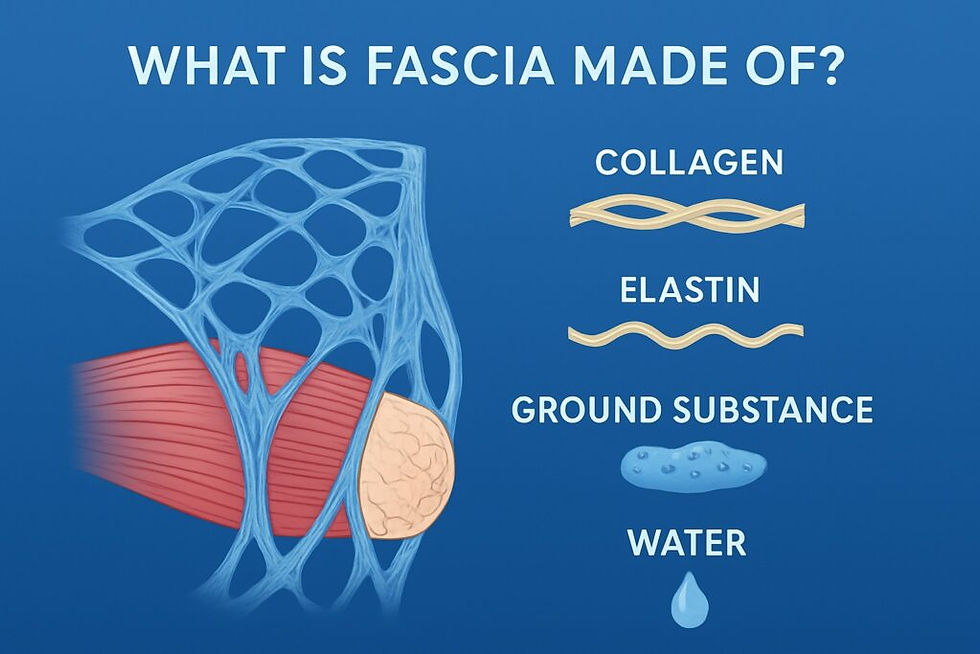
By wrapping different compartments, it allows these sections to smoothly glide and move over one another. This is one of the big functions of fascia - allowing movement to occur. Some sections of fascia have more collagen fibres that are distributed in a different way to provide more support and structure.

The fascia also has a number of nerve fibres and is a big contributor to proprioception. In particular there is a large density of mechanoreceptors that are highly sensitive to tension, movement and stretching. Healthy fascia sends clear signals for balance and coordination, but restrictions from injury or inactivity can impair these signals, leading to poor proprioception and chronic pain, as fascia also houses pain receptors (nociceptors).
Fascia's composition allows it to transmit forces, absorb impacts, facilitate movement, and provide sensory feedback (proprioception). A healthy, hydrated fascial network is crucial for efficient bodily function and injury prevention
There are different layers of fascia.
Superficial fascia is located just under the skin, with a layer of fat underneath, connecting skin to deeper tissues.
Deep fascia is denser connective tissue that surrounds organs like muscles, nerves, bones etc. It forms compartments and supports the body.
Muscle related layers (epimysium) surround muscles and sub compartments.

Why is fascia important?
Fascia is aligned over the body of the dog in a strategic way. This means that in different areas the amounts of fascia and collagen, and the arrangement of the fibres varies. This creates strategic areas of fascia that are tighter and more supportive, and other areas that are stretchier and designed to allow more movement, and encourage it in a certain direction.
This arrangement of fascia creates fascia lines that are designed to aid the biomechanical design of the dog in terms of their quadrupedal movement.
What happens when fascia is not working correctly?
Fascial adhesions (knots, restrictions) are when the fibres and arrangement of the collagen knots or twists, and becomes ‘stuck’. Adhesions mean that not only do the collagen fibres prevent movements, but also the tissue becomes dehydrated further restricting movement. Sometimes the adhesions can stick to other surrounding tissue.

This restricts movement generally, and may also interrupt the fascial lines, making the dogs movement patterns different. This can cause compensatory problems in other areas. These fascia adhesions can also cause pain as the sensory receptors in the tissue can be impacted.
Fascial adhesions can be caused by a number of things such as:
Inactivity
Dehydration
Muscle injury
Trauma
Repetitive strain
Surgery
Posture
Muscle overuse and tension (often from weaker muscles)
Inflammation
How to we assess fascia in a dog?
We can determine if there is potentially a fascia adhesion by feeling the fascia. Does it slide and move? Is the skin moving the same amount, in all directions over different parts of the dog? Can you feel easily movable little gristly lumps under the skin, over the muscle? All of these are indications of fascial adhesions. Often fascial restrictions can be seen by changes to fur patterns.

Resolving fascial knots and adhesions
The purpose is to restore the slide and glide of the fascia, so movement is not restricted.
We can work on releasing adhesions by:
Considering hydration
Adding heat to areas of tension and adhesions
Gently fascia work:
Flat hands gently pulling fascia apart to lengthen
Thumbs in semi-circles over adhesions
Flat hand gently and slowly pulling in the direction away from the adhesion
Flat hand gentle circles in both directions over adhesions
Skin rolling
Massage on the muscles related to the fascial adhesions
Active stretches
General movement, and strengthening muscles where there are fascial adhesions occurring regularly
Did you enjoy this? Here, take a look at this poster I made as part of my hydrotherapy studies. Also feel free to share this blog post!


Comments